A Village No Longer?

Blink:

Questionable geopolitics have been dominating the news lately. Makes me think about Hillary Clinton’s 2016 children’s book It Takes a Village.

Read On:

The premise of Clinton’s book was a story about diverse communities globally coming together to make a difference. People working, living together in harmony to make a better village. Many villages coming together can make a better world and build a better life for one another. Together we can change our world.

Show me the harmony:

  • During the cognition stage of the pandemic, we definitely witnessed how interconnected the world was. Now during the vaccination stage, we are experiencing a global supply chain disconnect. The leading pharmaceutical companies are in control and world leaders have failed to step in, establish policies, thus upper-middle income countries have received an estimated 80 percent of the vaccine doses. Low-income nations have been left out in the cold creating more global inequalities indicating world leaders have not put together a comprehensive plan. Consequently, we incur the risk of not ending the pandemic or preparing for the next coronavirus pandemic.
  • The Indo-pacific alliance is mutating impacting the future of who is aligned to counter China’s aggression. The recent Australian-British-U.S. nuclear submarine deal angered France who claimed they were not kept in the loop. They were already building low-enriched uranium nuclear submarines for Australia compared to the highly enriched propulsion fueled submarines outlined in the new deal. In addition to French President Macron’s fiery response, other members of the European Union questioned the alliance casting doubts about America’s commitment to diplomatic relations with Europe/NATO and long-term nonproliferation.   
  • Natural gas prices in Europe are going through the roof resulting in a rise in in household electric utility bills, as well as disrupting some industries. Some experts are attributing the energy crisis to Russia manipulating supply to pressure Europe to signoff off on a new giant pipeline given Russia is currently its reliable major supplier.   
  • The Iron Dome, the Israeli-American defense system/alliance does not bode well to advance the cause of potentially a peaceful two-state solution and might only further incite Hamas to continue their rocket attacks.
  • Climate change, climate change, climate change!

Above I have outlined a short list of disruptive geopolitics. My hypothesis, A village no longer. Right now, there appears to be no harmony. Why?Geopolitics lacks global leadership like an orchestra without a conductor.

Opinions welcomed!
Simplicity vs. Complexity

Blink:

I have been following the tang ping “lying flat” movement which originated in China, slowly gaining momentum. Chinese millennials and other young professionals globally are dropping out of the hypercompetitive rat race and adhering to a “slower lifesytle”– sleeping, reading, exercising and doing odd jobs.

Read On:                                                                                                                        

Tang ping I learned was instigated by a Chinese Millennial factory worker who drew his curtains one day, crawled into bed and posted his manifesto on Chinese social media about having the right to choose a “slower lifestyle.” He was inspired by a Greek philosopher who criticized the excesses of Athenian aristocrats. The manifesto went viral, popularized by young workers protesting the intense labor demands of China’s work culture. Resting/sleeping is a form of resistance for those who subscribe to tang ping. Now the movement has gone global, critics identifying it as a spiritual malaise protesting capitalism.

“Lying flat” is an extreme philosophy. Years ago, I remember all the buzz encompassing work–life balance, the mantra of workers aspiring to move up the corporate ladder. Work-life balance: the state of equilibrium where a person equally prioritizes the demands of one’s career and the demands of one’s personal life.

I respect people who take timeout to evaluate their core values and develop a lifestyle philosophy. True, work is a major component, but I believe most people tend to overlook the big picture. Specifically, how they live life simple or complex? I believe one major lifestyle cog are possessions or as the famous comedian George Carlin labeled stuff. Click and laugh. Possessions add complexity – staring with our homes(s), car(s), electronic gizmos, kitchen utensils, shoes, shoes, shoes, etc. Our digital time (a.k.a. TMI), as well managing hundreds of social media connections has added an element of complexity to life. Exercise routines have become more complex (gym time management plus equipment utilized) versus a simple walk, run or swim. Bottomline: We all have to choose the lifestyle formula which works best for us. A good starting point is to take timeout and evaluate your core values and then decide simplicity vs. complexity.

Back to Lou Huazhong the factory worker who posted the viral online “lying flat” manifesto. Is his life truly simple/slower, holed up in his room, curtains drawn, engaging on the Chinese social media platform Baidu, or complex managing his enormous online following?

Opinions welcomed!

Child Hunger

Blink:

“We may not be able to prepare the future for our children, but we can at least prepare our children for the future.” – FDR

Before the coronavirus pandemic, more than 10 million children lived in food-insecure households. Feeding America now estimates potentially 13 million children due to the pandemic

Read On:

Children facing hunger begin life at a serious disadvantage. They are more likely to face higher risks of health conditions (e.g., anemia, asthma, etc.) in their first few years. In addition, as they grow up hungry and miss regular, balanced meals they are more likely to have problems in school and other social situations. It is documented hungry kids might experience developmental impairments including language and motor skills which might result in falling behind in our educational system. In addition, hungry children tend to have more social (a.k.a. behavioral) issues. Feeding America in its quest to keep every child healthy, offers specialized programs – after school, summer, school food pantries to name a few.

Feeding America’s credo: We have a responsibility to the next generation to give them every opportunity to succeed – which in turn will strengthen our communities and our country. That’s why feeding children facing hunger is a main priority of Feeding America.

Low income is the most common cause of food insecurity. Unfortunately, many people in America struggle to meet their basic needs. Working families across America face countless situations that can result in food insecurity and hunger. Lay-offs at work, unexpected expenses (healthcare, automobile or household) can suddenly force a family to choose between buying food and paying bills. Click on the link to learn more about U.S. Household Food Insecurity and child hunger in America and how you can make a difference.

Opinions welcomed!

The Interconnectivity Impact – An Update

Blink:

A majority of my peers are cautiously optimistic about when the food-away-from-home channel will recover – one to two years. Realistically there are the “unknown unknowns.” Consequently, I believe it will take longer given the industry needs to analyze the interconnectivity impact.

Read On:     

I first addressed the Interconnectivity Impact back in July of 2020. My assertion was

Industry analysts to better understand when the food away-from-home channel was going to rebound needed to factor in the interconnectivity impact from other areas of economic recovery. Some of these areas will require more time, thus industry analysts need to temper their bullish timelines of one to two years. I thought this be a good time to update the interconnectivity impact.  

Travel & Tourism – The short-term revival of the restaurant industry has begun as dining restrictions have been lifted thanks to the increase percentage of the population vaccinated. This increase in volume can also be attributed to higher summer travel and tourism. Historically, the Restaurant Association’s research indicates, 1 out of every 4 sales dollars during the summer months in the industry can be credited to travel and tourism. However, the current surge and advance of the Delta variant might impede the restaurant industry’s recovery as some states are beginning to mandate a new set of restrictions. Travel analysts believe long-term the rebirth of tourism will take time depending on the return of corporate and international travel.

Hybrid Work Models – As offices begin to reopen and implement hybrid work models where some people continue to work remotely (full or part time), food & beverage sales will be diminished, especially lunch which before the pandemic was the number one restaurant daypart meal.

Higher Education – Updated figures from the National Student Clearinghouse Research Center (NSCRC) revealed that overall college enrollment fell to 16.9 million students last spring, a 3.5% decline versus the prior year. According to the NSCRC this was the largest spring semester enrollment decrease (600,000 students, primarily undergraduate) since 2011. Will enrollment continue to decline as college & universities start opening their doors and are trying to establish safety protocols, specifically as they implement vaccination mandates? Some are beginning to offer incentives like free parking to increase vaccination rates. Bottomline: it appears the overall population size of campuses across America will shrink, resulting in less food & beverage sales.

Reduced Labor Pool – Some foodservice operators are counting on the current staff shortages they are experiencing limiting their ability to properly service their seating capacities to be short-term. Unfortunately, the word is out, working in foodservice is not worth the “juice for the squeeze” – wages, hours, safety. In addition, especially in densely populated metro areas there has been a shift in population – individuals who worked part time to chase their dreams because their metro cost of living was prohibitive. Long-term those foodservice workers still working to cover the labor shortage might burnout, thus drop out.

Opinions welcomed!  

Marbles

Blink:

In recognition we are going to have to learn to live with the coronavirus, government officials globally suggest we use personal “social responsibility to maintain safety.” “Social responsibility to maintain safety?” Candidly, I am shocked to see how swollen the beaches are here in Cannes.

Read On:

A COVID-19 Update from France:

Throughout the pandemic like everyone I know, I have been trying to stay informed. Needless to say, virtually a full-time job. Back in September 2020 I watched on NHK TV (Japanese cable) an interview with Italian writer, physics PhD Paolo Giordano who published a series of essays “How Contagion Works.” His interview (note: I highly recommend watching) still resonates for me, especially when I observe the crowds flowing to the beaches here in Cannes. He compared the coronavirus contagion stage to an infected marble hitting and bouncing off several marbles resulting in a chain reaction where the newly infected marbles in turn hit and bounce off more marbles. We are experiencing this chain reaction with the insurgence of the highly contagious Delta variant. Consequently, France is experiencing a fourth epidemic wave of the coronavirus. President Macron instituted, a “health pass” for residents containing proof of vaccination or a negative COVID test to gain entry to most indoor venues including bars and restaurants. His goal was to place restrictions on the unvaccinated; 3.7 million people booked vaccine appointments in the week following his announcement. Regardless, despite being outdoors, all I envision is all the marbles stacked up on the beaches and at some point, the marbles on holiday will get thirsty or have to eat, thus patronize restaurants and café along the Bord de Mer hopefully with the proper documentation.

Scientists still do not fully understand the recent escalation of Delta variant infections globally given how highly transmissible it has been. Consequently, vaccination is the daily “buzz du jour.” In Europe, public opinion polls indicate overwhelming support for vaccines being the only way out of the pandemic. In the U.S. political differences have put numerous states on divergent paths. Yet daily, I read articles referencing the difference in inoculation rates between the E.U. and U.S like it is a competitive race. I strongly advocate globally we need to get on the same page so there are no infected marbles out there, especially as travel opens up.

Opinions welcomed!

COVID-19 Domino Collapse – Hybrid Workplace

Blink:

As vaccination rates increase, companies are currently being challenged to reopen their offices. One model being examined is the implementation of a hybrid workplace where workers will work both remotely and onsite. Unfortunately, the emergence of the Delta variant could play havoc on return-to-work plans.

Read On:

A hybrid workplace offers the current work force flexibility. Economists, project 20% of work will be done from home in light of numerous studies indicating remote workers have been more productive. A recent survey of 5,000 employed adults across the U.S. found 4 out of 10 workers expect some remote work type of arrangement. Regardless of what happens, I project there will be the COVID-19 domino collapse detailed below of ancillary businesses:

  • Formal business dress codes (suits & ties, dresses, shoes) replaced by casual attire (a.k.a. casual Friday – 5 days a week).
  • Food & beverage sales, especially lunch which before the pandemic was the number one restaurant daypart meal (note: martini lunches).
  • Office coffee services.
  • The water cooler business.
  • Transportation services including revenue generated from highway tolls.
  • Cleaning services & supplies.
  • Security.
  • The conference business and all the associated travel and entertainment businesses.
  • Daycare.
  • Personal grooming (as in hair salons, old fashion barber shops).
  • Shoe polish, professional shoe shiners in airports.

Opinions welcomed!

Forever Relevant – Clichés 2018

Blink:

Recently a friend of mine emailed me a list of corporate buzzwords. Great stuff! Jogged my memory about the list of commonly used clichés I posted back in 2018 – forever relevant.

Cliché (noun): A phrase or opinion that is overused and betrays a lack of original thought.

Read On:

  1. Authenticity.
  2. Awesome.
  3. Busy, Crazy.  I’m swamped.
  4. Collaboration.
  5. Disruptive innovation.
  6. Ecosystems.
  7. End of the day.
  8. Fake news.
  9. Start-ups.
  10. Sustainability.
  11. Transparency.
  12. Work/life balance.

OMG!

Comfort Zone

Blink:

I believe everybody agrees the COVID-19 health crisis in 2020 was an overwhelming disruptive influence in both our personal and working lives. A majority of people I engaged with experience some form of transformation (e.g., technology), but now believe we are returning to a state of normality. Are we?

Read On:                                                                                                     

I challenge the post pandemic concept of a return to normality. What is normality? Returning to your comfort zone? Comfort zone: (Noun) a situation where one feels safe or at ease; a settled method of working that requires little effort and yields only barely acceptable results.

An individual I am inspired by and have written about is Twyla Tharp, American dancer, choreographer and writer. Her mantra: Challenge the status quo, make way for the new. More Tharp Wisdom:                                                                                                                                                              

“The better you know yourself, the more you will know when you are playing to your strengths and when you are sticking your neck out.  Venturing out of your comfort zone may be dangerous, yet you do it anyway because our ability to grow is directly proportional to an ability to entertain the uncomfortable.”

Are you ready to venture out of your comfort zone in the new COVID world?

Rationale

Blink:

I have given thought to the validity of the rationale behind decision making.

Particularly, after the passing of Donald Rumsfeld former Secretary of Defense last month and his obsession for wordy, contradictory memos, more importantly his stance (a.k.a. rationale) on WMD’s leading to the Iraq war.

Read On:

Rationale (noun): a set of reasons or a logical basis for a course of action or belief.

Data driven decision making: In my last post regarding Social Enterprise, I referenced the CMO Survey as a great reference to better understand the transformation of marketing as it relates to emerging digital, social and political trends. Being a marketing geek, data utilized is a logical approach to make informed business decisions, yet according to the CMO survey only half of the companies (48.7%) reported using quantitative metrics. Only 2.3% implemented AI or machine learning, low, but more surprising only 4.1% will implement AI in the next three years. Fortunately, AI in decision making is being utilized in other areas, especially as it relates to our planet’s environmental health.    

As much as I am an advocate of data (a.k.a. stats) I am aware of the potential for “juking the stats” a term made popular on the HBO TV hit “Wired” where both in the public and private sectors, people reclassify data points to manipulate the rationale for a specified course of action. Sound ambiguous? What about the set of obstruse reasons or logic people use to make personal decisions, especially when it comes to unprincipled behavior?

Sensible decision making utilizes rationale.

The Future: Social Enterprise

Blink:

In my last post The Big Gap I addressed the global compensation culture and warned about the dangers of self-enriching executives. As the workplace continues to morph in the new Covid era, I believe occupants of corner offices should be more concerned about building social enterprises for long-term sustainable growth.

Read On:

As the number of people fully vaccinated increase (approximately 47.1% of the U.S. population (source: NPR Health News as of the July 4th weekend), more white-collar workers are gearing up to return to their offices. Thanks to the pandemic technology transformation of communication tools resulting from people working remotely, work place experts project businesses will create hybrid models in which workers will split their time between their office and home. A major leadership challenge for the C-suite – tech or leadership or both?

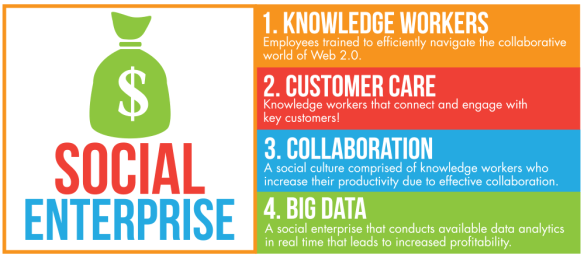
Technology is a given, especially with customers. One of my favorite resources for a better understanding the utilization of the digital world by corporations is the CMO Survey, a group created back in 2008 by Duke’s Fuqua school of business. In their latest survey released back in February, no surprise 73.8% of the respondents indicated they enhanced their digital marketing interfaces. Only 43.3% relied on data-based execution. Branding and companies taking a stand on social issues, especially COVID-19 and racial equality ranked high by a majority of the respondents, but varied by industry; B2C products being the highest at 85%. In regards to communications, 65.3% reported changes with approximately one half (48.7%) of the respondents indicating the changes were successful in contributing to their company’s overall performance. 53.4 % of the companies indicated there was a change in training, yet moving forward only 20.4% were going to spend money on training geared towards “Big Data”. I believe if companies are going to implement a hybrid workplace model, they are going to have to make the investment to train their people a priority on how best to navigate their digital toolbox to communicate internally and externally to build a social enterprise for long-term sustainable growth. The graphic below details the building blocks of a social enterprise – the future!

The Social Enterprise

Key words that appear in the first three building blocks in the above graphic: connect, engage and collaboration are derivatives of effective communications. The hybrid workplace will combine high tech remote working communications with low tech face to face coffee break room interactions. C-suite leaders should not expect communications will flow smoothly after the disruption created by the pandemic in their organizations. They will need to help establish the communication boundaries/guidelines needed to build a social enterprise, thus allocate money and resources to adapt to a hybrid work culture.

Occupants of the C-suite, are you prepared to make the changes needed to build long-term sustainable growth in the new COVID era?